


Digital image design has never been more accessible to the average business. Business owners, marketers, and designers can create polished visuals quickly using modern tools in a matter of minutes. On a screen, these designs often look complete. The colours are sharp, the text is clean, and the layouts feel balanced.
But large format printing is a different type of design, and what works on a laptop or phone does not always translate directly to a sign, wrap, or mural. There is a gap between digital artwork and physical production. Closing that gap is what turns a good idea into a high-quality finished product.
This is where many print jobs run into challenges. The artwork may look finished, but there is still technical work required before it is ready for wide-format output. Understanding that process helps avoid delays, unexpected costs trying to remedy poor output, and, of course, disappointing results.
Why Screen Designs Don’t Always Translate
An image on a digital screen and the same image shown in printed materials behave differently. A digital design is backlit, meaning colours appear brighter and more vibrant. Compare this to printed graphics, which rely on reflected light, which can make colours look softer or slightly ‘off’ at different times.
Resolution is something else that comes into play when comparing digital v. prints. A design that looks crisp on a screen may not hold up when it is scaled in a print several feet wide. Large format printing requires files that maintain clarity at size. If the resolution is too low, images can appear blurry or pixelated.
There is also the issue of scale. Of course, on a screen, a design might be viewed at a few inches wide and look terrific. In a large format setting, that same design could be expanded to cover a wall, vehicle, or storefront. Elements that originally looked balanced digitally may feel too small, too crowded, or out of proportion when enlarged.
These differences do not mean the design is wrong. They simply mean it needs to be adapted for format printing.
The Hidden Work Behind Print-Ready Files
Many customers assume that supplying artwork to a designer reduces the design time. In some cases, it does. However, customer-supplied files often require preparation before they are ready for printing services.
This preparation is not always obvious to a customer. It can include items like adjusting colours, rebuilding graphics, correcting resolution, or reformatting layouts. This can take time and be a task in itself. The goal, though, is always the same: to ensure the final product matches expectations when printed at full size.
As mentioned, some of the most common adjustments include converting colours from screen-based formats to print-ready profiles, increasing the resolution or replacing any low-quality images present in the design, adjusting thelayout and matching it to scale and viewing distance, and adding bleed and trim allowances for accurate cutting.
This technical work is essential for high quality results. Without it, even a well-designed file can fall short once it leaves the screen.
Common Challenges with Customer Artwork
Customer-supplied artwork often comes from tools like Canva or similar platforms. These tools are excellent for creating digital content quickly. They help businesses build social posts, presentations, and basic layouts.
However, they can create a false sense of completion. A design that looks finished on screen may not meet the requirements of large format printing. File sizes, resolution limits, and export settings can all affect the final output.
AI-generated artwork presents another challenge that many customers don’t know. These images can be visually impressive at first, but they are often created at sizes or resolutions that are not suitable for large format use. Untouched, these images can look downright terrible in large scale prints. They need to be refined and sometimes rebuilt before they are ready for print.
This does not mean these tools are not useful. They are valuable starting points. The key is recognizing that they are part of the process, not always the final step.
Designing for Real-World Surfaces
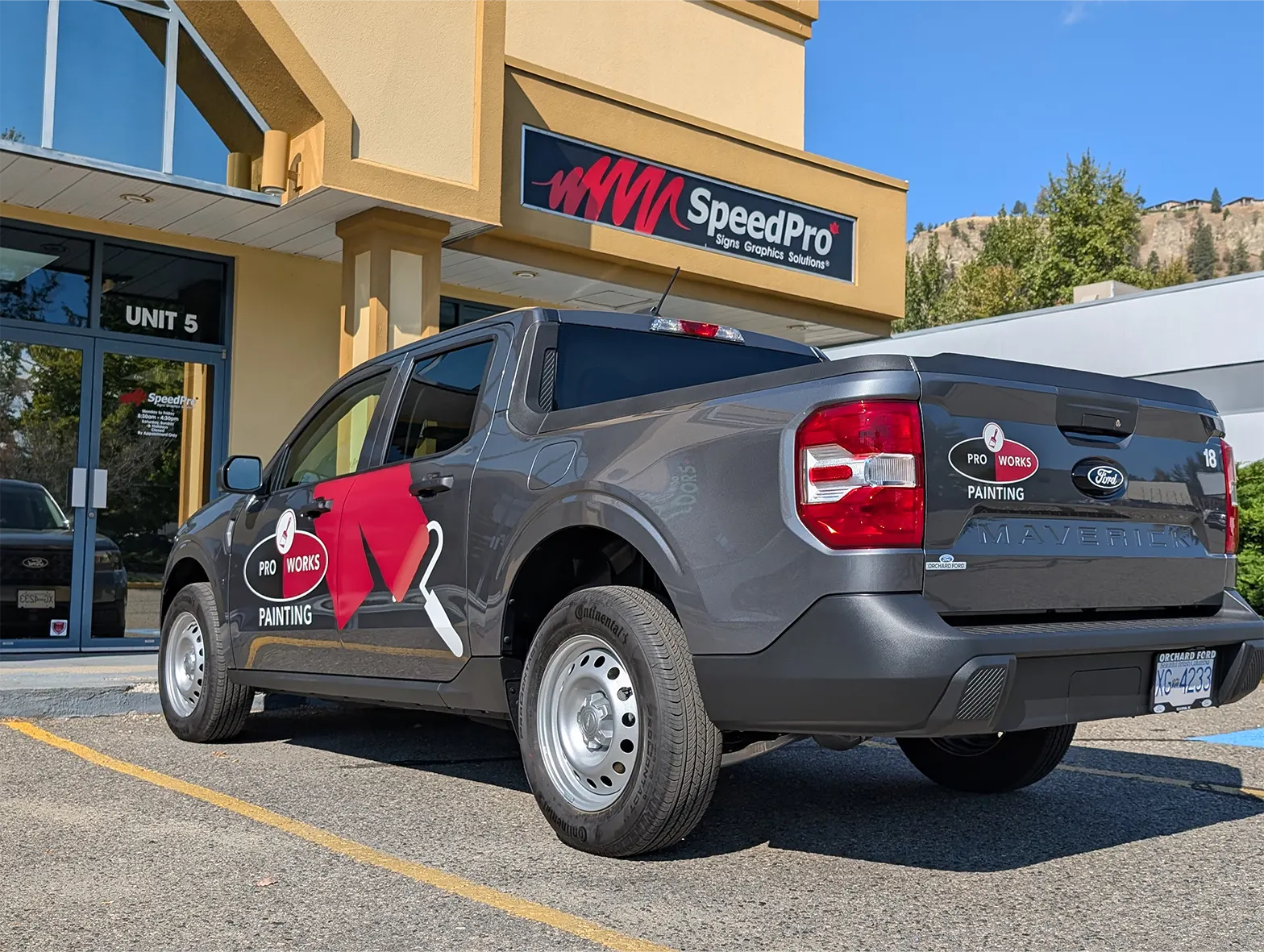
Large format printing is not just about size. It is about application. A design that works for a flat poster may not work for a vehicle wrap or wall mural.
Vehicle graphics, for example, require careful planning. Doors, windows, handles, and curves all affect how the design is applied. A logo placed too close to a seam or edge may become distorted or cut off. Text can become hard to read if it crosses complex surfaces.
The same applies to other large format applications. Wall murals must carefully optimize for texture and lighting. Outdoor signs need to remain readable from a distance. Trade show displays must balance their visual impact with clear messaging for the intended audience.
Designing for these conditions ensures the final product looks intentional and professional. It also helps avoid costly adjustments during installation.
What Makes Artwork Print-Ready
Creating artwork for large format printing involves more than exporting a file. It requires a combination of design thinking and technical preparation.
Print-ready artwork should be clear, scalable, and suited to its environment. It should account for viewing distance, material choice, and installation conditions.
Here are a few simple indicators that a file is ready for large format use:
- Images remain sharp at full size
- Colours are adjusted for print, not just screen
- Layout considers edges, seams, and trim areas
- Text is readable from the intended viewing distance
When these elements are in place, the transition from screen to sign becomes much smoother.
The Role of Large Format Visual Branding Partner
Sign and graphic solution providers are needed when it comes to producing the best quality large format graphics one can. They bridge the gap between digital design and the physical output and help ensure artwork translates well to real-world conditions.
Among the services a print shop can assist with includes critiquing files, identifying potential issues, and making adjustments where needed. They ensure you’re selecting the right materials and printing methods for every project, such as whether it’s a banner, wrap, or rigid sign.
Working with experienced printing services helps reduce risk. It ensures that the final product not only looks good but also lasts and performs as expected.
Setting the Foundation for Better Results
When you understand the fundamentals of how digital artwork translates to large format printing, it provides you with the knowledge to arrive at a better finished product. It helps businesses plan more effectively and avoid common pitfalls.
Ready to Move Forward With a Print-Ready Design?
Large format printing is about more than scaling up a design. It is about adapting that design for the real world. When artwork is properly prepared, it becomes more than a visual. It becomes a functional, durable, and high quality communication tool. Have artwork you’re not sure is print-ready? Contact us at Speedpro Kelowna and reach out for a professional file review or quote. Get expert guidance to make sure your design translates perfectly from screen to sign.


